
DSTV No Signal Repairs
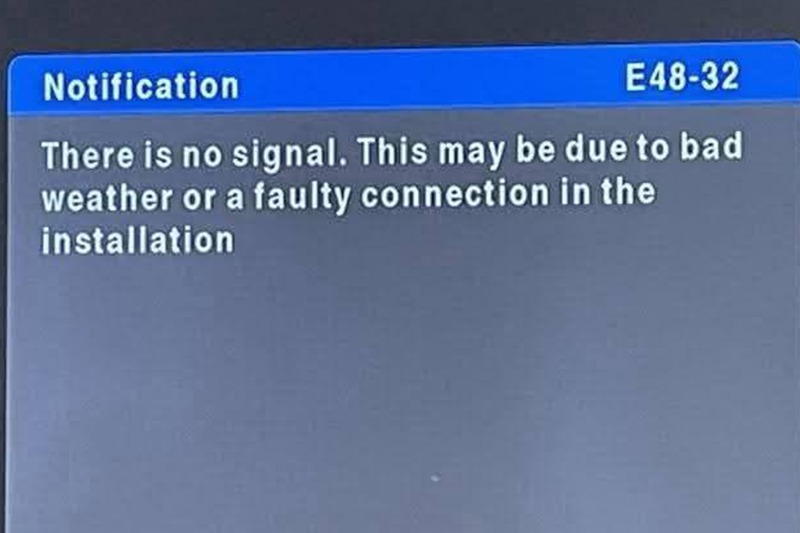
The DSTV no-signal error (E48, "Searching for Signal") is the most common fault we attend to in Gauteng. It almost always traces back to a hardware or alignment issue, not a subscription problem.
What Usually Causes This Problem
Most cases trace back to one of the following root causes. Our technicians diagnose with a signal meter and the right diagnostic tools on every callout.
Dish misalignment after storms or wind
Even a 1° shift in dish alignment can drop the signal completely. Gauteng's summer thunderstorms regularly knock dishes off-aim. We realign with a signal meter on site.
Failed LNB
Lightning surge, water ingress or simple age (8-12 years is normal lifespan) all kill LNBs. Replacement is straightforward and we carry stock.
Water-damaged coaxial cable
Older RG-6 runs eventually take on water at the dish-end F-connector, corroding the inner conductor. We cut back to clean cable and re-crimp.
Corroded F-connector
Outdoor F-connectors corrode over years of Highveld weather. A single corroded joint kills signal completely.
Smart card pairing issue
Less common but possible — the card has lost its MultiChoice pairing. We re-pair live during the visit.
Decoder fault
Rarely the cause — but possible. We test by swapping cabling or trying a known-good decoder.
E48 and E48-32 are not the same error
This is worth getting right, because it decides whether you need a technician at all. DStv's own error catalogue lists these separately:
- E48 — "Searching for Signal". The decoder is not receiving an adequate signal from the dish. On a clear day this is a genuine hardware or alignment fault.
- E48-32 — "Weather". Stormy weather and rain. This clears on its own once the weather passes and nothing needs fixing.
So the first question is not which code you are seeing but what the sky is doing. E48-32 in a Highveld thunderstorm is rain fade — every satellite service in the world does this, and a bigger dish will not stop it. E48 under clear skies, or E48-32 that persists long after the storm has gone, is a fault.
Five things to check before you book a callout
- Look outside. Heavy rain or thick storm cloud? Wait it out.
- Power-cycle at the wall. Not the remote — switch the decoder off at the plug for at least 10 seconds, then on. This clears a surprising number of transient faults.
- Check the cable behind the TV. Finger-tight at the decoder's LNB IN socket. A cable pulled half-out during a TV move is one of the most common causes we attend to.
- Look at the dish from the ground. Visibly tilted, hanging, or with a branch in front of it? That is your answer.
- Check the signal screen. On most decoders, Menu › Settings › Signal (or the dish setup screen) shows signal strength and quality. Quality is the number that matters. Strong signal with low quality usually means interference, a failing LNB or a water-damaged cable — not alignment.
What a proper diagnosis looks like
A technician who arrives, wiggles the dish until the picture returns and leaves has not fixed anything — they have found a position that works today. Correct practice is a signal meter at the dish, checking both strength and quality across transponders, then locking the mount so it holds through the next storm. If the LNB is degraded it gets replaced rather than nudged, and corroded F-connectors get cut back and re-crimped rather than taped.
Common questions
DStv's official catalogue titles E48-32 as “Weather” — stormy weather and rain interfering with the signal. It clears on its own once the weather passes. The separate code E48 is “Searching for Signal”, which on a clear day points to a dish, LNB or cabling fault.
This is rain fade. Heavy rain absorbs and scatters the satellite signal on its way to your dish. It affects every satellite service and is not a fault. If the picture does not return once the weather clears, the storm has probably shifted the dish or damaged a connector.
Sometimes. Power-cycle the decoder at the wall for at least 10 seconds, check the cable is firmly seated at the decoder, and look at the dish for obvious damage or obstruction. If the signal quality reading stays low after that, it needs a meter and a technician.
Most are resolved within the standard callout — typically under an hour. Realignment, LNB replacement and connector repairs are all done on site, and we carry spare LNBs, connectors and cable.
Related pages
Related DSTV Solutions
See our FAQ page for 50+ answers, or contact us for a same-day quote.